

What you need to know about Seoul
Seoul, the capital of South Korea, is a huge metropolis where modern skyscrapers, high-tech subways and pop culture meet Buddhist temples, palaces and street markets. Notable attractions include futuristic Dongdaemun Design Plaza, a convention hall with curving architecture and a rooftop park; Gyeongbokgung Palace, which once had more than 7,000 rooms; and Jogyesa Temple, site of ancient locust and pine trees. Seoul is known for its vibrant districts, eclectic fashion scene, delicious street food, and for being the birthplace of K-pop and Hallyu. Despite being a technologically advanced country, Seoul is still famous for its historical sites and traditional culture.
Currency
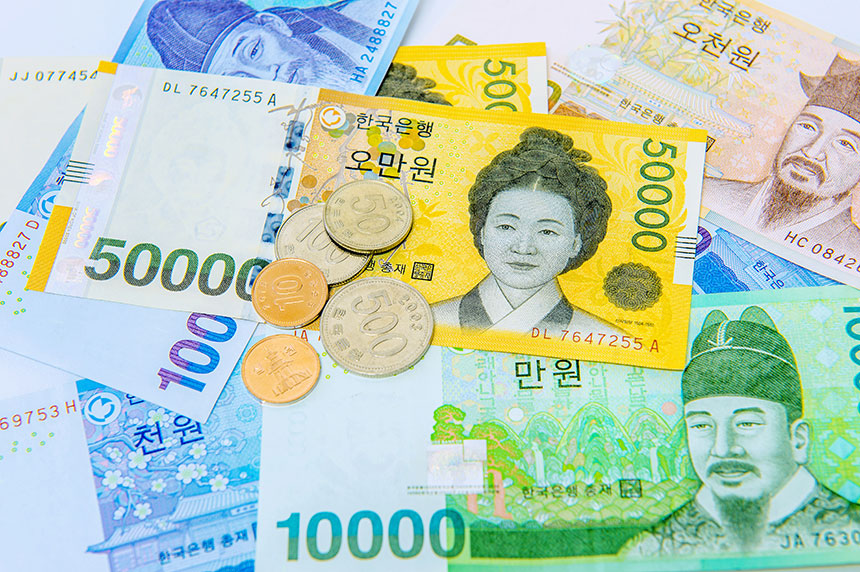
Korea’s currency is the won. Paper money comes in denominations of 1,000; 5,000; 10,000; and 50,000 won bills. Coins come in 1, 5, 10, 100, and 500 won (1 and 5 won coins are not widely circulated).
Banks
Banks usually offer the best exchange rates to travelers. Banking hours can vary, but most have business hours from 09:00 to 16:00. ATMs typically operate until 23:00, but many are open 24 hours a day. ATMs can also be found at convenience stores, but often charge higher transaction fees. ATMs that accept international cards are common and are marked with a “Global” sign or the logo of the international banks they accept cards from. Most ATMs offer foreign language services, including English, Chinese, and Japanese.
Koreans share one language, with approximately seventy million people around the globe speaking Korean.
The language grammar and vocabulary are in some ways similar to Japanese; the structure differs. Dialects are regional; differing mainly in accent, but are so similar that comprehension for speakers, or listeners, is not an issue. Key difference in dialect are also attributed to social status.
Korea has one of the highest literacy rates in the world due to the phonetic nature of the written language which was invented in the mid-fifteenth century to give one language to Koreans.
Religion & Beliefs
- South Korea supports religious freedom
- Confucianism, Buddhism and Christianity are the main formal religions
- Many Koreans believe in the ancestral spirit and observe Confucian rituals
- Confucianism is a political and social philosophy that pervades Korean culture
Major Celebrations/Secular Celebrations
- There are two main national holidays
- New Year’s Day (second full moon after winter solstice)
- Chuseok (the eighth full moon)
- Celebrations for these festivals are based around ancestors, family, games, harvest festivals and food.
The Family
- The family unit is an integral part of customs and life in South Korea
- Arranged marriages are common
- Marriage is regarded as a rite of passage
- Divorce was rare but has become more common in recent years
- Patriarchal lineage is ubiquitous and links ancestors through the husband’s line
- Traditionally, the eldest son inherited, however, this has recently altered and is now equal by law
- The eldest son bears extra responsibility to his family and it is supposed that he will care for his parents in their old age
Social Stratification
- Since the Kabo Reforms of 1894 there has been no traditional gentry
- 60% of Koreans considered themselves to be middle class
- Class position is often linked to educational attainment
- Industrialisation and urbanisation contribute to class difference
- Family, upbringing, wealth, education and occupation contribute to social standing
- Symbols of status include; large homes, chauffeur driven cars, dress, membership to certain clubs, and higher educational degrees
- Urbanisation is 82.5% of total population (2015)
- Language is hierarchical and one must address social superiors in a fitting manner
Gender Roles
- Equality of the sexes is constitutional
- Daily life is dominated by male guidance within a primarily patriarchal society
- Social organisation is influenced by gender and age
- 47.7% of adult females worked outside the home (1998)
- Women occupied 2.3% of provincial and local seats in (1999)
- Women dominate Shamanism as priestesses but have limited roles within Christian and Buddhist religions
- Women are expected to be submissive in public situations and at informal gatherings
- Women are considered more independent than their male counterparts
Socialisation
- Daily care of infants is primarily parent based for at least the first two years with little, or no, separation from the mother
- Patriarchal obedience, cooperation, respect for elders, and familial piety are imbued into early childhood
- Gender specific roles are encouraged within the family and education system
- Sons generally receive the best education and remain more dependent upon their family, even into marriage
The Economy
- South Korea changed from an underdeveloped country, to the 11th largest economy globally, within one generation
- South Korea is heavily dependent upon exports for its GDP; almost half of its business is exported through products or services
- 48% of all exports are electronic
- 31% of exports are transport related (cars, boats, etc)
Food
- Korean cuisine is based on rice, vegetables and meat
- ‘Kimchi’ is the national dish and is eaten with most meals
- Kimchi is made from a variety of vegetables which are then fermented and can be stored for long periods of time
- Banchan are side dishes – these are often made in large numbers and are served along with the main dish
- Food is used in ceremonies, especially at weddings, birthdays and to honour ancestors
Arts, Humanities & Popular Culture
- Historically, Chinese and Japanese influences were seen in South Korean art; aesthetic concepts and motifs were shared
- Korean music and arts were linked to natural cycles and religion, giving rise to a folk culture in rural areas that are still considered popular
- ‘Gangnam Style’ by Psy, a South Korean musician, achieved worldwide fame in 2012. The song refers to the Gangnam District of Seoul, a trendy, classy area, equated with London, Paris or Hollywood
- Foreign influences have produced a fast food and coffee culture in recent years, especially within Seoul
- Language has altered with the introduction of some Western phrases such as ‘eye shopping’ (window shopping)